A simple truth about content creation is this: the best piece of content you’ll ever create can die quietly because of a bad name. Not bad writing. Not bad design. A weak title. Before anyone reads your paragraph, sees your layout, or looks at your poster’s artwork, they read six to ten words — and those words decide everything.
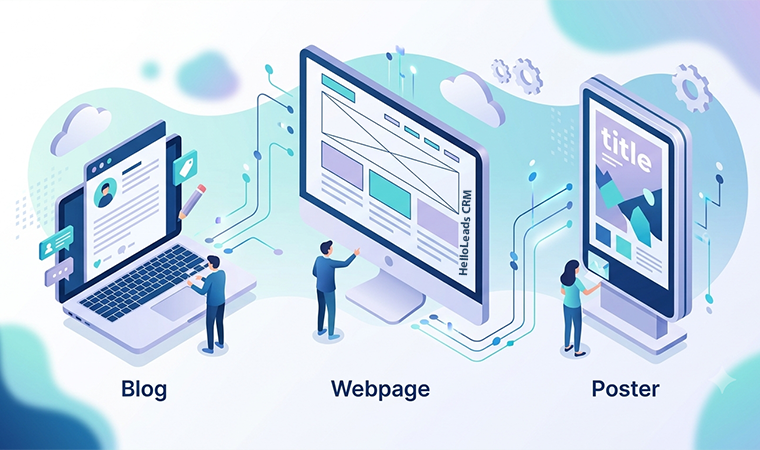
This guide breaks down why plain names fail, the core psychological hooks that make names more engaging, and how the naming job actually changes depending on whether you’re titling a blog post, a webpage, or a poster.
Why Plain Names Fail
A name like “Weekly Sales Report” or “About Us” isn’t wrong — it’s just invisible. Three things kill a plain name:
- It informs instead of inspiring. It states a fact but sells nothing. There’s no emotional reason to click.
- It’s generic and forgettable. No unique angle, no specific benefit to the reader — it could belong to anyone’s content.
- It gets scrolled past. In a crowded feed, search results page, or gallery wall, a flat name competes for milliseconds of attention and loses.
Compare “Weekly sales report” to “The 3 surprises hiding in this week’s sales” — same document, radically different pull. The second version creates stronger curiosity and can improve engagement because it highlights a clear benefit, simply by shifting from informational to magnetic.
A strong name matters because it does five jobs at once: it stops the scroll, triggers an emotion (curiosity, fear of missing out, desire), clarifies the value (answers “what’s in it for me?”), boosts your metrics (open rate, click-through rate, shares), and — done honestly — builds credibility instead of burning it.
The Six Hooks That Make Names Magnetic
These formulas work across blogs, webpages, and posters alike. Think of them as flavor profiles you can mix and match.
1. The Secret / Hidden Hook
People naturally want to discover information others don’t know.
Examples:
- The Hidden Cost of Poor Lead Management
- The Secret Behind High-Converting Sales Teams
- What Successful Businesses Do Differently
2. The Fear of Failure Hook
Nobody wants to lose opportunities.
Examples:
- Stop Losing Revenue from Facebook Leads
- Don’t Let These CRM Mistakes Hurt Your Business
- Why Your Website Isn’t Generating Customers
3. Challenge Conventional Thinking
Challenge common beliefs.
Examples:
- Why Spreadsheets Are No Longer Enough
- Everything You Know About CRM Is Changing
- Forget Traditional Sales Tracking
4. Promise a Transformation
Focus on the outcome.
Instead of:
Mobile CRM Features
Write:
How Mobile CRM Helps Sales Teams Close More Deals
5. Curiosity Gap
Encourage readers to discover the answer.
Examples:
- The One Sales Habit Nobody Talks About
- Why Some Leads Convert While Others Don’t
- What Every Sales Manager Should Know
6. Number-Based Headlines
Lists remain one of the highest-performing headline formats.
Examples:
- 7 CRM Features Every Sales Team Needs
- 10 Mistakes That Kill Sales Productivity
- 5 Golden Rules of Image Prompting
Additional psychology-backed patterns worth keeping in your back pocket: questions (“Do you know how to…?”), negatives (“Never write a boring headline again”), and audience-referencing (“For anyone about to hit publish”). The mechanism is always the same — surprise, tension, or a clear personal stake pulls harder than a flat statement of fact.
Naming Isn’t One-Size-Fits-All: Blogs vs. Webpages vs. Posters

The hooks above are universal, but how you deploy them changes with the format.
Naming a Blog (or a blog post title)
- Keep it scannable. Aim for roughly 60 characters so search engines don’t truncate it, and so it reads cleanly at a glance.
- Balance clarity and curiosity. A title should be specific enough to set expectations but interesting enough to spark curiosity — “How to Write a Blog Post Outline” is clear; “How to Write a Blog Post Outline That Actually Works” adds a hook without losing clarity.
- Put the keyword near the front, but let it read naturally — a title should serve humans first, search engines second.
- Numbers and brackets still perform. Formats like “7 Ways to Future-Proof Your Content [2026 Edition]” combine a number, a benefit, and a freshness signal in one line.
- Use the year sparingly. It’s useful for content that goes stale (tools, stats, how-tos) but adds little value — and unnecessary length — to evergreen or conceptual posts.
- Naming the blog itself (the brand, not a single post) is a different task: it needs to be short, brandable, and durable across hundreds of future posts, rather than optimized for one moment of curiosity.
Naming a Webpage

- Function first. A webpage title (and its meta title) often needs to describe what the page does — a landing page, a pricing page, an about page — so visitors and search engines both know instantly where they are.
- SEO structure matters more here than novelty. Webpage titles are judged heavily on keyword relevance and how they render in a search snippet, so clarity usually wins over cleverness.
- One big idea per page. Avoid clutter — focus on a single strong verb and one compelling benefit, especially on conversion-focused pages like landing pages or product pages.
Naming a Poster
- You get almost no room and almost no time. A poster is read from a distance, often in seconds, so the name has to work as a visual anchor as much as a verbal one.
- Short, punchy, and emotional wording works better than descriptive titles. A poster title should work like a powerful visual headline rather than a full explanation.
- Design and words are one decision. Because a poster is seen before it’s read, hook style should match visual tone: a “Fear of Failure” hook pairs well with bold, high-contrast design, while a “Curiosity Gap” hook pairs well with negative space and a single withheld visual element.
How AI Can Help You Create Better Titles
AI is an excellent brainstorming partner—but only if you ask the right questions.
Instead of prompting:
“Give me a title.”
Try:
Generate 10 SEO-friendly blog titles under 60 characters. Include emotional hooks, avoid clickbait, and explain which psychological trigger each title uses.
You can also ask AI to:
- Rewrite a plain title
- Add curiosity
- Improve SEO
- Reduce clickbait
- Generate titles for different audiences
- Score titles based on engagement potential
The 5-Step Title Creation Framework
Step 1: Start with the Topic
Example:
Mobile CRM
Step 2: Identify the Reader’s Goal
Sales productivity
Step 3: Add an Emotional Trigger
Competitive advantage
Step 4: Include the Keyword
Mobile CRM
Step 5: Keep It Concise
Aim for:
- 50–60 characters for SEO titles
- 6–12 words for posters
- Clear and readable language
Before and After Examples
| Basic Title | Better Title |
|---|---|
| CRM Guide | The CRM Guide Every Growing Business Needs |
| Patent Analysis | Patent Landscape Analysis: Your Competitive Advantage |
| AI Sales | How AI Tools Are Transforming Modern Sales Teams |
| Business Quote | How to Prepare a Business Quote That Wins Customers |
| WhatsApp CRM | Stop Losing Customers Through WhatsApp |
Notice how the improved versions focus on benefits and outcomes rather than simply naming the topic.
Common Mistakes to Avoid
- Writing titles that are too generic
- Stuffing keywords unnaturally
- Making promises the content cannot fulfill
- Using excessive punctuation or ALL CAPS
- Creating clickbait that damages credibility
The best titles create curiosity while accurately reflecting the content.
Pro Tips for Writing Better Titles
- Start with the reader’s problem, not your product.
- Include a clear benefit or outcome.
- Use numbers where appropriate.
- Keep titles concise and easy to scan.
- Test multiple variations before publishing.
- Balance emotional appeal with SEO.
- Ensure the content delivers on the title’s promise.
A Simple Title Checklist
Before publishing, ask yourself:
✔ Does the title clearly explain the topic?
✔ Does it spark curiosity?
✔ Does it promise value?
✔ Is the primary keyword included naturally?
✔ Is it under 60 characters (for SEO titles)?
✔ Would you click it yourself?
If the answer to most of these questions is “yes,” you’re on the right track.
Conclusion
A great title is more than a label – it is your content’s first sales pitch. Whether you’re writing a blog, designing a webpage, or creating a poster, the right title can significantly improve visibility, engagement, and conversions.
By combining the psychological headline techniques from the attached playbook with AI-assisted brainstorming and SEO best practices, you can consistently create titles that attract attention, build trust, and encourage action.
Remember: People don’t read great content unless a great title convinces them to click first.