
In periods of uncertainty, the stories that endure are not always about flawless winners—they are about unlikely ones. History has a way of reminding us that progress often comes from places we least expect. One such story is Seabiscuit, a racehorse who rose from obscurity during the Great Depression to become a symbol of belief, resilience, and unconventional success.
For today’s business leaders, Seabiscuit’s journey offers a powerful reminder: true growth rarely comes from choosing the obvious option. It comes from recognizing untapped potential—and creating the right system for it to thrive.
A Rough Beginning: Potential No One Noticed
Born in 1933, at the height of the Great Depression, Seabiscuit was not built like a champion. He was small, awkward, and lacked the elegance expected of elite racehorses. As a two-year-old, he raced constantly—35 times in 1935—but with little to show for it. Trainers dismissed him as lazy, difficult, and unreliable. Often, he was reduced to serving as a practice horse for others.
In many ways, Seabiscuit resembled overlooked talent in organizations today—employees with capability but no system designed to understand or support how they actually perform best.
A Nation Searching for Hope
By the mid-1930s, America was struggling. Unemployment was widespread, businesses were failing, and confidence was shaken. People weren’t simply looking for winners; they were searching for reassurance that perseverance still mattered.
Against this bleak backdrop, an unlikely contender began to capture attention—not just because he won, but because he represented the possibility of redemption.
The Right People Make the Difference
Seabiscuit’s transformation wasn’t driven by the horse alone—it was shaped by a team that understood what it meant to be underestimated.
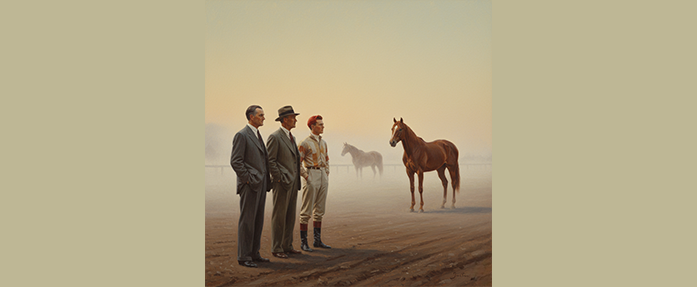
- Charles S. Howard, the owner, had rebuilt his life after personal loss and financial hardship.
- Tom Smith, the trainer, rejected conventional methods and relied instead on patience and observation.
- Red Pollard, the jockey, had grown up in poverty and faced repeated setbacks in his career.
Each of them knew what it felt like to be overlooked. That shared understanding allowed them to see something others had missed.
Turning a Weakness into a Strength
What many saw as Seabiscuit’s flaw turned out to be his defining advantage. He resisted force. Whips and pressure caused him to shut down. Instead of trying to “fix” him, Tom Smith chose to understand him.
Smith noticed that Seabiscuit loved competition. When he could run alongside another horse—when he had something to chase—he surged forward with intensity.
The team adjusted their approach:
- Training focused on head-to-head competition instead of isolated drills
- Pollard encouraged Seabiscuit verbally rather than using force
- Race strategies positioned him to pursue rather than lead
The result was remarkable. Once the environment aligned with his nature, Seabiscuit transformed into a fierce and determined competitor.
This lesson applies far beyond horse racing. Whether it’s people, processes, or customers, performance improves when systems adapt to natural behavior instead of forcing conformity.

A Rise That Captured the Nation
Between 1937 and 1940, Seabiscuit became a national icon.
- In 1937, he won 11 major races and became America’s top money-earning horse.
- In 1938, he defeated Triple Crown winner War Admiral in a legendary match race at Pimlico—watched by over 40,000 spectators and millions on the radio.
- That same year, he was named Horse of the Year, despite never competing for the Triple Crown.
At a time when hope was scarce, Seabiscuit’s victories reminded people that greatness could emerge from unlikely places.
A Fitting Finale
After multiple injuries, Seabiscuit returned for one final race in 1940 at Santa Anita. Older, battered, and underestimated once again, he defied expectations and won the Santa Anita Handicap with Red Pollard aboard. Shortly after, he retired.
His career record told a story few would have predicted:
- 89 races
- 33 wins
- $437,730 in earnings—an extraordinary sum for the era
Leadership Insight: Success Comes from Enablement, Not Force

Seabiscuit didn’t succeed because his weaknesses were eliminated. He succeeded because someone chose to understand him—and then built the right environment around that understanding.
The same principle applies to modern organizations. High-performing teams are rarely uniform. People think differently, customers behave differently, and growth is rarely linear. Leaders who excel are not those who impose rigid systems, but those who design frameworks that observe, adapt, and enable.
For sales leaders, Seabiscuit’s story carries a lesson that is easy to overlook in performance-driven environments.
Sales success is rarely about forcing everyone to sell the same way.
Some salespeople thrive in fast-paced, competitive situations. Others excel when they build relationships quietly over time. Some respond to pressure; others shut down under it—just like Seabiscuit did. When leaders apply one rigid approach to every salesperson, potential often goes unnoticed.
The most effective sales leaders do what Tom Smith did: they observe before they optimize.
They pay attention to how individuals actually perform, not how they are “supposed” to perform. They create clarity instead of pressure, visibility instead of micromanagement, and alignment instead of uniformity. In doing so, they allow each salesperson to compete from their natural strength.
Sales teams also deal with customers who don’t behave predictably. Not every prospect follows the same journey. Not every deal moves at the same pace. Growth comes when teams stop forcing linear processes and instead learn to recognize patterns, timing, and intent.
Seabiscuit didn’t become great because his flaws disappeared. He became great because the environment finally matched his nature. The same holds true for sales teams.
When leaders shift from control to enablement, from assumption to understanding, and from pressure to clarity, performance follows. Often, the breakthrough isn’t about hiring new talent or pushing harder—it’s about seeing differently.
Final Thought
Seabiscuit was never the obvious choice. But he became the winning one because someone believed enough to understand him. For sales leaders today, the message is simple and timeless:
Don’t force performance. Enable it.
Because when people are allowed to sell in ways that align with their strengths, even unconventional talent can achieve extraordinary results.